FoVaS

FoVaS Annual Workshop
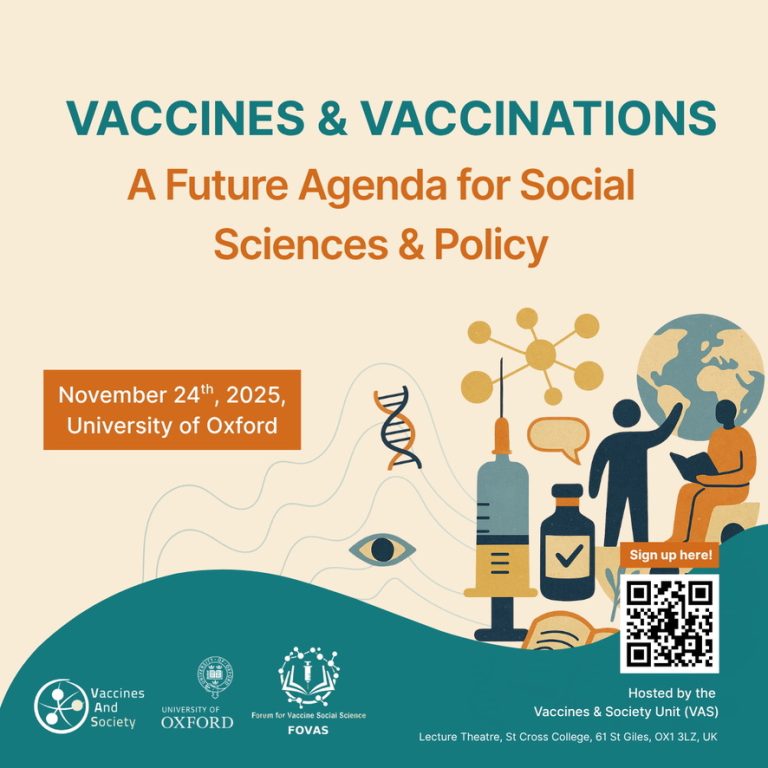
On 24 November 2025, the University of Oxford’s Vaccines and Society Unit (VAS) convened vaccine scientists and social scientists from across the University and the wider global community to examine the challenges hindering global vaccine rollout and explore how social science methods can help address both current and emerging obstacles.

The Forum for Vaccine Social Science (FoVaS), a network of 17 scholars from 16 countries, opened the workshop, with organizers Stuart Blume and Samantha Vanderslott welcoming participants and outlining the network’s aims. Blume underscored the importance of understanding vaccines as public health tools rather than cures. He noted that reducing discussions to “vaccine policy” or “coverage” risks overlooking the broader social, political, and mobilizational work that drives effective vaccination efforts. He urged attendees to reflect on how the day’s discussions could translate into tangible outcomes within their own communities, reminding them that documents alone do not enact change – people do.

Throughout the morning, four working groups reported on their collaborative efforts in the months leading up to the workshop, with Laura Mamo and Mia-Marie Hammarlin chairing, and Katharina Paul, Maria Brujic, Tracey Chantler, Ben Kasstan-Dabush, and Ken Shadlen as respondents.

Watch The Session Recordings

Presentations
Keynote
Panel Presentation

1. Conceptualizing Vaccines

Led by Giampietro Gobo, this first group examined how vaccines are framed within wider systems of thought and how current political and policy environments shape these narratives. They highlighted the limitations of public debates that reduce vaccine views to being simply “for” or “against,” or to matters of individual choice. Instead, they encouraged re-framing discussions around multi-factor worldviews shaped by diverse and non-universal human experiences. With global biomedicalization and growing social crises influencing vaccine perceptions, they stressed the need for context-specific responses that acknowledge the heterogeneity of communities worldwide.

2. Equity and Equality

Led by Ramila Bisht and Tolu Osayomi, this working group explored intra- and international inequalities that affect under-served and minority communities, particularly in vaccine research representation and equitable access. Participants reflected on factors shaping coverage, including political instability, distrust, religious beliefs, and, critically, limited educational opportunities for women. The group emphasized the need to analyze inequities within communities rather than relying on universal frameworks, arguing that nuanced, contextually grounded approaches are essential for achieving long-term solutions.

3. Trust and Confidence

Led by Katie Attwell this group focused on the relational and reciprocal nature of trust. They highlighted how mistrust and stigma can emerge on both sides of the doctor–patient relationship, often fueled by inconsistent encounters and inadequate contextualization of problems and solutions. This dynamic, combined with imperfect or incomplete clinical evidence, creates fertile ground for misinformation. The group also called for greater attention to pharmacovigilance within regulatory structures and how it can be better integrated into trust-building strategies.

4. Sovereignty and Autonomy

In the final presentation, Gabriela Bortz, led a discussion on the work their group had done examining national-level vaccine production, supply, and regulation. They argued that mastery of vaccine technology underpins sovereignty, enabling countries to tailor vaccine development and delivery to local needs. Such autonomy, they noted, can strengthen public trust, expand scientific capacity, and ensure affordability, particularly during outbreaks. Supporting national investment in vaccine science, they argued, is crucial for ensuring that locally relevant contexts inform responses to emerging pathogens.

Following a summary of the morning from Purendra Prasad and Jeremy Ward, the workshop then moved into a wide-ranging discussion among participants from FoVaS, Oxford, and the global social science community. Conversations spanned resource availability, communication successes and shortcomings, and the evolving landscape of vaccine hesitancy. 

An analytical roundtable on vaccine futures, politics, and society featuring Bernice Hausman who chaired, with presenter Alan Silva and panelists Ken Shadlen, Ann Kelly, Valentin-Veron Toma, and David Franco, preceded a keynote from Sir Andrew Pollard, who illustrated the historical impact of childhood vaccines and explained how the UK’s immunization schedule has adapted over time.

The meeting closed with strengthened networks and a deeper shared understanding of the factors shaping present and future vaccine rollout efforts.

(Written by Hannah Shrader)
Vincen Gregory Yu

Vincen Gregory Yu is a physician and medical anthropologist from the Philippines. He is currently pursuing his PhD in anthropology at the University of Sydney, using an ethnographic lens to understand the vaccination landscape in the Philippines in the aftermath of the COVID-19 global public health emergency. Before pursuing his PhD, he obtained his MD from the University of the Philippines Manila and MA in anthropology from the University of Sydney, where his dissertation project on COVID-19 vaccine hesitancy in the Philippines won best thesis prizes from the Australian Anthropological Society and the Association of Southeast Asian Studies. His research foci include the politics and anthropology of infectious diseases, epidemics, and pharmaceuticals, as well as drug policy and illicit drug use. His work has been published in Social Science & Medicine, Vaccine, Global Public Health, International Journal of Drug Policy, Health Policy and Planning, and BMJ Global Health, among other peer-reviewed journals. At present, he is also a research affiliate of the Ateneo de Manila University Department of Development Studies, and board member of the Anthropological Association of the Philippines.

Maurizia Mezza

Maurizia Mezza is a medical anthropologist working on pharmacovigilance, with a particular focus on vaccines, and on the intersections of climate change and health. She received her PhD from the University of Amsterdam. Her research examines biomedical interventions and explores possibilities for global care beyond biomedicine. She has published in peer-reviewed journals including Critical Public Health and Social Science & Medicine, as well as contributing to press and media coverage. Maurizia has worked across academia and the NGO sector, including roles as Director of Programmes and Research and in Monitoring and Evaluation. She has co-led transdisciplinary research on dengue and diarrhoeal disease in the Amazon. Her work is grounded in co-creative and participatory methodologies and experiments with innovative forms of dissemination.

Tolulope Osayomi

Tolulope Osayomi is a Senior Lecturer and Medical Geographer in the Department of Geography at the University of Ibadan, Nigeria. He holds a PhD in Medical Geography from the University of Ibadan and has over a decade of teaching and research experience. His scholarship examines how geography shapes health and disease in African contexts, with core interests in disease mapping, spatial demography, global health, medical humanities, and the geography of pandemics & vaccination. During the COVID-19 pandemic, he founded and directed the COVID-19 Mapping Lab at the University of Ibadan (2020–2021), providing geovisual representations of the pandemic in Nigeria and West Africa, and his research interrogated the “African COVID-19 Paradox.” He is currently a TORCH International Fellow at the University of Oxford’s Medical Humanities Research Hub, and has held visiting positions at Oxford and Northwestern University, USA. Osayomi is Guest Editor of a special issue on Geospatial Responses to COVID-19 in Africa (Springer Nature) and a Fellow of the Ife Institute of Advanced Studies and the Nigerian Science Leadership Programme.

Laura Mamo

Laura Mamo is the Health Equity Institute Professor of Public Health at San Francisco State University, USA. Her research and teaching lie at the intersection of medical sociology, gender, sexuality, and queer studies, and the social and cultural studies of science, technology, and medicine. Mamo is the author of the books Sexualizing Cancer: HPV and the Politics of Cancer Prevention (University of Chicago Press, 2023); Queering Reproduction: Achieving Pregnancy in the Age of Technoscience (Duke University Press, 2007); co-author of Living Green: Communities that Sustain (New Society Press, 2010); and co-editor of Biomedicalization Studies: Technoscience and Transformations of Health, Illness and U.S. Biomedicine (Duke University Press, 2010). https://healthequity.sfsu.edu/node/13

Purendra Prasad

I am a sociologist at the University of Hyderabad in India and a senior research fellow at the School of Public Policy, University of Massachusetts, Amherst, USA My research examines structural inequalities across health, agrarian, environmental, and urban sectors in India through an interdisciplinary political economy lens. I focus on analysing how state and market forces have progressively heightened the iniquitous health care system, including vaccination policies and programmes impacting different classes, castes and genders. My work raises questions on equity and access to health care, autonomy and sovereignty of nations within right to health framework. My recent book publications include: Equity and Access: Health Care Studies in India (OUP 2018, co-edited) and Politics of the Anthropocene and Climate Crisis in India: (Routledge UK 2025, co-edited).https://share.google/v3r2XBNjKa0MtOtgt

Bernice L. Hausman

Bernice L. Hausman, Ph.D., has been writing about medical controversies in the public sphere since the early 1990s. She serves as the Garner James Cline Professor of Humanities in Medicine and Chair of the Department of Humanities at Penn State College of Medicine (USA). She received her undergraduate degree in literature from Yale University and her doctoral degree in women’s studies from the University of Iowa. The author of four scholarly books, most recently Anti/Vax: Reframing the Vaccination Controversy (Cornell UP 2019), Dr. Hausman identifies and interprets the sociocultural imaginaries animating medical modernity.

Katie Attwell

Professor Katie Attwell is a political science and public policy scholar at the University of Western Australia, and a global expert in vaccine hesitancy and vaccination policies for childhood and COVID-19 vaccines. A key area of expertise is mandatory vaccinations, which are the topic of her forthcoming book with OUP. Katie currently leads “MandEval: Mandate Evaluation” exploring COVID-19 vaccine mandates and their impact in Australia, Italy, France, California and the United Kingdom. Prof Attwell has published in Nature, Pediatrics, Milbank Quarterly, and Social Science and Medicine. With her team, she researches vaccination policymaking in Australia, the US, Europe, and Asia.

Marija Brujić

A social anthropologist and senior research associate at the University of Belgrade, where I hold a PhD in ethnology and anthropology. I also have an MSc from the University of Oxford. Additionally, I have been a visiting scholar at both the Universities of Graz and Amsterdam. My ethnographic fieldwork includes research among Serbian diaspora in Austria, Slovenia and the Netherlands. My research interest in vaccines derives from my parental experience, life in post-socialist Serbia and my background in anthropology of science. Currently, I am carrying out research on childhood and the Covid-19 vaccination among Roma in formal/informal settlements across Serbia.

Jeremy Ward

I'm a sociologist and senior researcher at the French National Institute of Health and Medical Research (INSERM) in Paris and a member of the French NITAG. I'm interested in the emergence of public debates and public attitudes to science on medical issues. My approach lies at the intersection of political sociology and sociology of science. My work has focused mainly on vaccination in France, but also on a range of other subjects such as the prescription of hydroxychloroquine as a treatment for Covid-19 and public perceptions of what constitutes a conflict of interest, and of clinical trials. I am also among the coordinators (with Patrick Peretti-Watel and Pierre Verger), of the Social and Human Sciences network on Vaccination in France which aims to foster interdisciplinary debates around vaccination as well as international collaborations among social science researchers interested in vaccination (https://shs-vaccination-france.com/en)

Elize Massard da Fonseca

Elize Massard da Fonseca is an Associate Professor at the Getulio Vargas Foundation (FGV), Brazil. She specializes in the political economy of pharmaceutical regulation, health industrial policy, and the politics of infectious diseases, with research supported by funding from the São Paulo Research Foundation. Her work has been published in leading journals such as Research Policy and The New England Journal of Medicine. She has contributed to advancing understanding of how health industries and regulatory institutions shape access to medicines in the Global South.

Stuart Blume

Stuart Blume is Emeritus Professor of STS at the University of Amsterdam. He has worked at the University of Sussex, the London School of Economics, for the British government, and as advisor to NSF, OECD, UNESCO, and the World Federation of the Deaf. He has been visiting professor/researcher in Bucharest, Cuenca (Ecuador) Montreal, Oslo, and Paris.  Publications include Insight and Industry: On the dynamics of technological change in medicine (MIT Press 1992); Immunization. How Vaccines Became Controversial (Reaktion 2017/21 plus various translations), and (ed with Baptiste Baylac-Paouly) Immunization and States: The Politics of Making Vaccines (Routledge 2021).

Paulina Polak

I am an Associate Professor at the Institute of Sociology at Jagiellonian University in Krakow. My research is driven by a deep interest in medical sociology, specifically regarding vaccines, vaccine hesitancy, technological changes and the public sphere. My work also explores the intersections of the legal, the social and technologies, looking into human rights, patients' rights, health policies and innovations. I am passionate about putting research into practice. To that end, I recently led a project creating a VR application designed to help doctors improve their communication with parents who are hesitant or skeptical about vaccinations.

Giampietro Gobo

He is professor of Science and Technology Studies at the University of Milan (Italy). His interests concern the sociology of senses, the sociology of expertise, and scientific controversies on health issues (e.g. immunization policies). He is currently undertaking ethnographies on heteroception. He wrote extensively on qualitative, quantitative, mixed methods, and STS. His books include Qualitative Research Practice (co-edited with C. Seale, J.F. Gubrium and D. Silverman, Sage 2004), Doing Ethnography (Sage, 2008), Constructing Survey Data: An Interactional Approach (with S. Mauceri, Sage 2014), Merged Methods: A Rationale for Full Integration (with N. Fielding, G. La Rocca and W. van der Vaar, Sage 2021), Rethinking Ethnography (with P. Chomczyński and G. Lampredi, Elgar forthcoming). Also, Science, Technology and Society: An Introduction (with V. Marcheselli, Palgrave 2022).

Gabriela Bortz

Gabriela Bortz is an Associate Professor at the Research Center for Transformation, Economics and Business School, Universidad Nacional de San Martín (CENIT-EEyN-UNSAM/CONICET, Argentina), and an Adjunct Associate Professor of Science, Technology, and Society (STS) at Universidad Nacional de Hurlingham (UNAHUR). She has been a Fulbright Visiting Fellow at the Harvard STS Program (2021), a Brocher Foundation Fellow, and a Visiting Professor at TU-Munich and Universidad Federal de Paraná (2024). Her research explores the intersection of Science, Technology, and Innovation policies, socio-technical imaginaries, and biotechnology governance -especially in health- as a promise for inclusive development in Latin America.

Samantha Vanderslott

I am a health sociologist and Associate Professor at the University of Oxford, leading the Vaccines and Society Unit (VAS) hosted by the Oxford Vaccine Group and the Pandemic Sciences Insitute. My work centres around health, society, and policy topics. I draw on perspectives from sociology, anthropology, history, global health, and science and technology studies (STS). I seek to understand key themes determining vaccine support and opposition, particularly highlighting activism from a pro-vaccine perspective and addressing questions posed by public policies aiming to encourage or mandate vaccination.